
The best way to store coffee beans is in one opaque, airtight container, kept in a cool, dark cupboard away from the stove, and bought in small batches you’ll finish within a few weeks. Light, heat, air and moisture are what flatten a bag. Keep those four away from the beans and the last cup will taste a lot like the first.
What is the best way to store coffee beans?
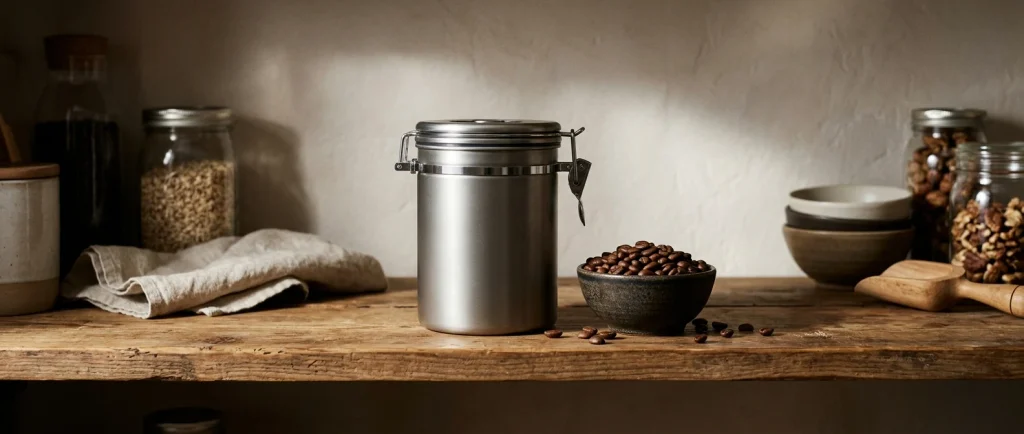
Use one container with a tight lid that blocks light, and put it somewhere cool and dark. That is the whole system, and it works with almost any bag of beans.
I like it because it asks so little. No gadgets, no schedule, no special shelf. You pour the beans in, close the lid, and put it back in the cupboard. The next morning it smells the way the bag did when you first tore it open.
Everything else in this article is a detail on that one habit. Opaque, airtight, cool, small batches. Four things, and they’re easy to remember at six in the morning.
Why do coffee beans go flat so quickly?
Roasted beans start losing their aroma and flavor the moment they cool, and air, light, heat and moisture all speed that up. Oxygen dulls the oils that carry the sweetness and the smell. Light and warmth push the same process along faster.
You notice it in the cup before you can explain it. The coffee is still brown and still hot, but it’s quieter. The sweetness fades first, and what’s left tastes papery or just plain bitter.
Ground coffee goes flat even faster, because so much more of each bean is exposed to air. That’s one reason I keep whole beans and grind at the last minute. If you want the longer version of why whole bean matters, I wrote about it in Whole Bean Coffee Changed My Life.
Where in the kitchen should the container live?
A cupboard that stays cool and dark, away from the stove, the toaster and the window, is the best home for your beans. The spot next to the coffee maker looks lovely and is usually the wrong one.
Think about what that corner of the counter goes through in a day. The machine warms up, the kettle steams, and afternoon sun comes through the glass. A canister sitting there gets warm and bright and warm again, every single day.
I’d rather walk three steps to a cupboard. A shelf near the pantry, a low cabinet on an inside wall, a drawer that never gets sun: any of these works. You want the spot to feel a little forgotten, like a place where nothing changes.
The container can still be a pretty one. Just keep it where the room’s weather doesn’t reach it.
Should you keep coffee beans in the freezer or the fridge?
Keep them out of the fridge, and use the freezer only for a sealed, unopened bag you won’t get to for a while. That’s my firm but friendly position, and I hold it loosely.
The fridge is the clear no. It’s damp, it’s full of food smells, and coffee soaks up odors easily. Nobody wants a hint of last night’s leftover onions in the morning cup.
The freezer is the more tempting mistake, and it isn’t a disaster. The trouble comes from taking a container in and out. Each time you open a cold one in a warm kitchen, moisture condenses on the beans, and moisture is exactly what you’re trying to avoid. Do that every morning and you’ve traded one problem for a worse one.
If you do freeze, here is how I’d go about it:
- Buy a bag you really can’t finish in time, or a bulk bag you want to share out.
- Divide it into portions that each last about a week.
- Seal each portion airtight, with as little air inside as you can manage.
- Take out one portion at a time, and let it come to room temperature before you open it.
- Don’t put a thawed portion back in the freezer.
That’s a reasonable use of the freezer. Using it as the daily home of your beans isn’t.
How much coffee should you buy at once?
Buy about what you’ll finish in two to three weeks. That’s my preference, and it matters more than any container you own.
A big bag feels like a good deal and a small bag feels like a chore. But the last third of a large bag, three or four weeks after you opened it, is rarely the coffee you paid for. Fresh, smaller bags that keep arriving taste better than a giant one that slowly fades.
Look for a roast date on the bag, not just a best-by date. A roast date tells you how old the beans really are, and it lets you plan around it. Beans often taste their best some days after roasting, so a bag you open a few days after the roast date is nothing to worry about.
A simple way to work out your own number: weigh what you use in a typical week, then multiply by two or three. If you brew one cup a day, a small bag lasts a good while. If the household drinks a pot every morning, you’ll want to buy more often, and that’s fine.
Which containers are worth keeping on the counter?
The best container is an opaque one with a lid that seals well, and a glass jar works too if it lives inside a cupboard. Here’s how the four common options compare.
Coffee Bean Storage Containers Compared
The best container blocks light and has a lid that closes well. Here’s how four common options compare.
| Container | Blocks light? | Seals against air? | My take |
|---|---|---|---|
| Original valve bag | Blocks light? Usually yes | Seals against air? Depends on how well the bag reseals | My take Fine for short-term storage if it closes securely. Move the beans if the bag won’t reseal well. |
| Ceramic canister | Blocks light? Yes | Seals against air? Depends on the lid and gasket | My take Looks good on the counter, but check the seal and keep it away from heat and direct sunlight. |
| Stainless steel canister | Blocks light? Yes | Seals against air? Depends on the lid and gasket | My take Sturdy and easy to wipe clean. A good everyday pick if the lid fits well. |
| Glass jar in a cupboard | Blocks light? Only because of the cupboard | Seals against air? A well-fitting rubber-gasket lid can provide a good seal | My take Works well if the cupboard stays dark and the lid closes tightly. |
Quick tip: Whatever container you choose, wash it between bags and let it dry completely before adding fresh beans.
The original bag. Many bags have a one-way valve that lets gas escape, and that’s useful before you open it. After that, the bag is hard to reseal fully. I’d use it for the first stretch and then move the beans to a proper container if the bag is going to last longer.
Ceramic. It blocks light and looks good beside the kettle. The seal is the question mark, so look closely at the lid before you buy.
Stainless. It’s tough, it doesn’t hold smells, and it fits a busy kitchen. Same advice on the lid: a loose one wastes the point of the metal.
Glass. I love how it looks, and clear glass on an open counter is a poor idea. In a closed cupboard, though, it’s perfectly good.
Whatever you choose, wash it and dry it completely between bags. Old coffee oils build up on the inside and can turn rancid, which then flavors the fresh beans.
How can you tell your beans have gone stale?
Stale beans smell faint, look dull or dry, and make a cup that tastes flat, papery or bitter with no sweetness behind it. Your nose will tell you before your tongue does.
Open the container and breathe in. Fresh beans smell sweet, rich and a little alive. Stale ones smell like cardboard, or like nothing much at all. If the smell is weak, the cup will be too.
A few other signs:
- The brew has little crema or bloom. When hot water hits fresh grounds, they puff and rise. Old ones barely move.
- The coffee tastes thin even though you haven’t changed the recipe.
- The beans look very dull and dry, or have an oily, sticky film that smells sharp or sour. That’s a sign the oils have turned.
- The cup is bitter and hollow, without the fruit or caramel the bag promised.
Stale coffee isn’t dangerous, just disappointing. If you’ve got some left, a strong cold brew or an iced coffee with milk can hide a lot. But next time, buy a smaller bag.
Storage works best alongside fresh grinding. Beans kept well and then ground right before brewing taste noticeably better, and I go into the tools for that in Burr Grinder vs Blade Grinder for Home Coffee. Good storage gets you to the grinder with beans worth grinding.
Which airtight, opaque canisters would I keep on my counter?
If I were choosing, I’d look first at two on Amazon: the Airscape ceramic canister and the Fellow Atmos stainless canister. This is a preference, not a pitch, and either would do the job.
The Airscape is ceramic, so it blocks light, and its inner lid is designed to press down and push air out of the canister. I like it for how it looks sitting out. It suits a kitchen where the coffee corner is part of the room.
The Fellow Atmos is stainless and opaque, with a lid you twist to pull air out. I like it for a cupboard or a busy counter, where something sturdy and quiet makes sense.
Both do the same thing: keep light and air away from the beans. Either one, filled with a small bag and kept somewhere cool, will do more for your coffee than any trick I know.
A good canister, a dark shelf and a bag you finish in time. That’s the standard I hold, and the coffee shows it.
Coffee bean storage FAQs
What is the best way to store coffee beans?
Keep whole beans in a clean, airtight, opaque container in a cool, dark, dry cupboard. Grind only what you need for each brew.
Should I store coffee beans in the fridge?
No. The fridge can expose coffee to moisture and odors from other foods. A cool, dark cupboard is a better place for beans you use regularly.
Can I freeze coffee beans?
Yes, for longer storage. Seal the beans in portions you can use at once. Let a sealed portion thaw before opening it, and do not refreeze it.
How long do opened coffee beans stay fresh?
The National Coffee Association gives a general room-temperature freshness window of one to three weeks for opened whole beans stored airtight. This is a guideline, not an exact cutoff.
Can I store coffee beans in a glass jar?
Yes. Use a jar with a well-fitting lid, then keep it inside a dark cupboard so light does not reach the beans.