
Pour over is the slow version of coffee. Not slow like inconvenient, slow like a kettle, a timer, and ten minutes where you’re not doing anything else. If you already love coffee, that’s the part worth learning. Not the gadget, not the ritual for its own sake, but the fact that a pour over brings out flavor a drip machine just can’t get to. The same beans, brewed by hand, taste brighter. Cleaner. More like themselves.
A lot of people try pour over once, get a cup that’s either weak and sour or thick and bitter, and quietly go back to their machine. That’s almost never a taste problem. It’s a technique problem, and it comes down to three things: how fine you grind, how hot your water is, and how you pour it. Get those three right and the rest takes care of itself.
The Gear You Actually Need (and What You Can Skip)
You need a dripper, a filter, a kettle, a scale, and a grinder. That’s the whole list.
The dripper can be ceramic, glass, or plastic. Buy whichever one looks nice on your counter, because the material matters far less than people online will tell you. A Hario V60 or a Kalita Wave are the two most common starting points, and either one will serve you well for years.
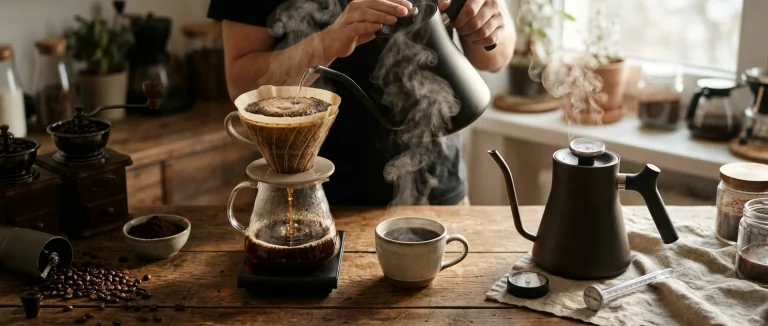
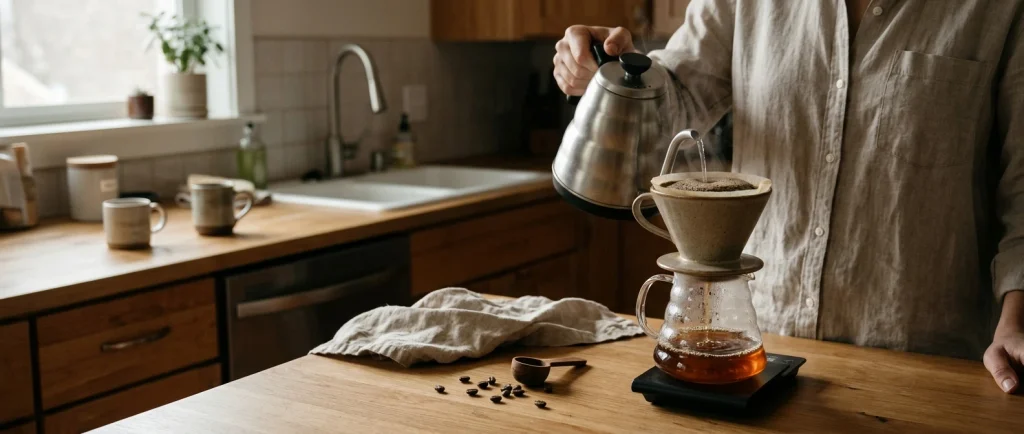
The kettle matters more than the dripper does. A gooseneck kettle, the kind with the long, narrow spout, gives you control over where the water lands. You can buy an electric one with a built-in thermometer, or a cheap stovetop version and a separate thermometer. Either works.
A scale is the one piece of gear that feels optional and isn’t. Pour over is a recipe, and recipes need measurements. Eyeballing water and coffee is how you end up with a different cup every single time.
What you can skip: specialty filters, a dedicated coffee pouring stand, anything marketed as “barista grade” without explaining what that means. None of it changes the cup as much as the box it comes in suggests.
The grinder is the one place I’d tell you not to cut corners, and if you’re still working with a basic blade grinder, I’ve written a full breakdown of what to look for instead. Grind consistency affects pour over more than any other single variable on this list, including the water.
Choosing and Grinding Your Beans for Pour Over
Pour over flatters beans that have something to say. A light or medium roast, something with a named origin on the bag rather than just “dark roast blend,” is where this method shows off. The acidity and the fruit notes that get buried in a French press come forward in a pour over cup.
Grind size for pour over sits in the medium range, somewhere between the fine texture of table salt and the coarser grind you’d use for a French press. Picture something close to coarse sand. Too fine, and water struggles to pass through, sitting too long against the grounds and pulling out bitterness. Too coarse, and water runs through fast, leaving you with something thin and sour.
This is where a blade grinder lets you down. It chops unevenly, giving you a mix of dust and chunks in the same batch, so some of your coffee over-extracts while some under-extracts, in the same cup, at the same time. A burr grinder solves that by crushing beans to a consistent size, which is the whole reason it’s worth the upgrade before anything else on this list.
Water Temperature and Ratio That Actually Matter
Water just off the boil, somewhere in the 195 to 205 degree range, is the sweet spot. Too hot and you scald the grounds, pulling out sharp, bitter flavors. Too cool and the coffee tastes flat, like it never fully woke up.
Ratio is just as important as temperature, and far easier to get consistent. A common starting point is one gram of coffee for every sixteen to seventeen grams of water. For a single cup, that lands around 20 grams of coffee to 320 grams of water. Weigh both. Taste will tell you if you want it a little stronger or a little lighter, and you can adjust the ratio next time rather than guessing in the moment.
One thing people underestimate completely is the water itself. If your tap water is hard or heavily chlorinated, it will flatten even great coffee, no matter how carefully you grind or pour. I’ve gone deeper into how hard water affects both flavor and your equipment here, and it’s worth a read before you assume your technique is the problem.
The Pour Over Technique, Step by Step
Start by rinsing your paper filter with hot water. This warms the dripper, removes any papery taste, and the water drains into your cup or carafe, which you then dump out.
Add your ground coffee to the filter and give the dripper a gentle shake so the bed sits flat. Place it on the scale, and zero it out.
Start your timer and pour just enough hot water to saturate all the grounds, roughly twice the weight of your coffee. This is the bloom. You’ll see it puff up and release gas, a sign the beans are fresh. Let it sit for 30 to 45 seconds.
Begin pouring in slow, circular motions, starting from the center and spiraling outward, then back in. Keep the water level steady rather than flooding it all at once. Pour in two or three stages, pausing briefly between each, until you reach your total water weight.
Let the final water drain through completely before you lift the dripper away. Total brew time, start to finish, usually lands between two and a half and four minutes. Much faster or slower than that, and your grind size is the first thing to adjust.
Common Mistakes That Make Pour Over Taste Bitter or Weak
Bitter coffee is almost always one of three things: too fine a grind, water that’s too hot, or a brew time that ran too long because the first two slowed everything down.
Weak or sour coffee usually points the other direction: too coarse a grind, water that wasn’t hot enough, or a pour that moved too fast for the water to extract properly.
Pouring too aggressively, dumping water straight down the middle instead of circling it, disturbs the coffee bed and causes uneven extraction. Some grounds get hit hard, others barely get touched.
And skipping the bloom is a quiet mistake a lot of beginners make. Fresh coffee releases carbon dioxide, and if you don’t let that gas escape first, it pushes back against the water you pour next, which keeps it from soaking into the grounds evenly.
Dialing In Your Brew Over the Next Few Cups
Your first pour over probably won’t be your best one, and that’s fine. Change one thing at a time. If it’s bitter, grind slightly coarser next time. If it’s thin, grind slightly finer, or raise the ratio of coffee to water. Keep the other variables steady so you know what actually moved the needle.
Write it down if that helps, even just a note on your phone: grind setting, water temp, ratio, how it tasted. After four or five cups, a pattern shows up, and from there you’re not guessing anymore, you’re repeating something you already know works.
That’s the whole appeal of pour over. It rewards small, specific attention rather than expensive gear or barista training. A good cup, made slowly, on purpose, by hand.
If you’re still brewing with a basic blade grinder, check out the grinder guide here before your next pour over. Grind consistency matters more than any other single step, and it’s the easiest upgrade to make before your next cup.
Pour Over Coffee FAQs
What is a good coffee-to-water ratio for pour over?
A good starting ratio is 1 gram of coffee to 16 grams of water. For one cup, try 20 grams of coffee with 320 grams of water, then adjust to taste.
What grind size should I use for pour over coffee?
Start with a medium grind, roughly like coarse sand. If the coffee tastes bitter, try a coarser grind. If it tastes weak or sour, try a finer grind.
Should I bloom coffee before making pour over?
Yes. Pour a small amount of hot water over the grounds and wait 30 to 45 seconds. This gives gas released by the coffee a chance to escape and starts wetting the grounds.
Why does my pour over coffee taste bitter?
Bitter coffee can come from a grind that is too fine, water that is too hot, or a brew that takes too long. Try a slightly coarser grind first and change one variable at a time.